How to Engage All 3 Brains and Master Your Second Act w/ Joya Dass - Ep. 56
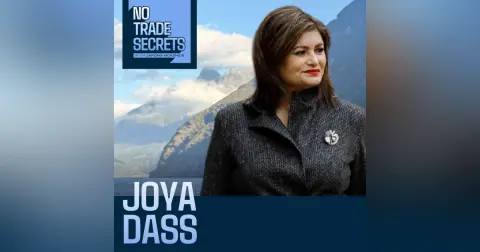

From a 27-year career as a TV news anchor on the floor of the NYSE to leading storytelling immersions abroad, Joya Dass has mastered the art of captivating an audience. In this episode, Joya unpacks why our attention spans have plummeted to just 7 seconds and how to engage the entire brain—not just the data-driven part. She shares her framework for helping women in their "second act" turn a lifetime of wisdom into a powerful public presence, and why physically removing yourself from your daily routine is the secret to unlocking your next level of growth.
💡 Unlocking the Playbook
Engage All Three Brains: To truly captivate an audience, you must engage their animal brain (stakes), emotional brain (sensory details), and prefrontal cortex (data). Simply sharing data only engages one-third of their capacity and leaves massive connection on the table.
Champion the Second Act: Women aged 55-70 are being aged out of the workforce, taking invaluable institutional knowledge with them. Joya's work focuses on capturing that wisdom and teaching them the art of thought leadership to build their own consulting businesses and secure their legacy.
Defeat Stage Fright with Service: Shift your mindset from "public speaking" to an "act of service." When you focus on solving your audience's most pressing problems and educating them from your experience, your own anxiety fades into the background.
Clear Writing, Clear Thinking, Clear Speaking: The foundation of powerful public speaking isn't performance; it's clarity. By establishing a daily writing practice and road-testing your core stories, you build the confidence and mental sharpness to speak clearly on any stage.
Leverage Enclosed Cognition: 78% of communication is nonverbal, and your wardrobe is a critical tool. Dressing in high-quality, well-tailored clothing (not necessarily branded) sends a subconscious message of success that makes people want to be a part of your journey.
🤫 The No Trade Secret
You've got to focus. I think without focus, you don't set anything up for success.
🗣️ Words to Build On
"When you can tell a story with high stakes, a great deal of emotion, and then back it up with numbers, you have got all 3 brains lighting up and you've got everybody in the room captivated." – Joya Dass
"Clear writing leads to clear thinking leads to clear speaking." – Joya Dass
"I think running a business inflicts a lot of war wounds. And I don't think that you realize how much healing needs to happen when you are away." – Joya Dass
👤 About Joya
For 27 years, I was a TV news anchor. I delivered business news from the floor of the New York Stock Exchange. I loved it because it was intelligent reporting. There was science, technology, and the very act of talking about business that made it interesting. In 2010, I launched a business teaching women in business how to become better public speakers. Today, I work with women in their second acts, ages 55–70, to become better public speakers through immersions abroad. The courage that says “yes” to that trip is the kind of courage I need to galvanize for storytelling on a stage.
🔗 Links & Resources
- Website: https://joyadass.substack.com/
- Email: joyarani@gmail.com
Today we're joined by Joya Das. Joya heads the Women's Leadership Lab, a global storytelling agency. She lives abroad 30 days each quarter, and her American clients come to work with her. Before that, she spent 27 years as a TV news anchor. She delivered business news straight from the New York Stock Exchange floor. And she was drawn to the science, the tech, and the smart reporting on business. In 2010, she launched a business teaching woman in business how to become better public speakers. And today, she works with women in their second acts, age 55 to 70, on public speaking emergence abroad. The courage that says yes to that trip is the courage she wants to galvanize for storytelling on that stage. Joya, thank you, and welcome to the show.
SPEAKER_01Jerome, thank you for having me. It's always great to hear your your world and your life read back to you.
SPEAKER_00Yeah, no, I feel like whenever there's a bio read about yourself, it kind of puts it in perspective how much you actually have done in a career or in a lifetime, you know, like and how the world sees you and all the different things that you know can be kind of fleeting and you can kind of lose track of the big picture of everything, uh, especially in an entrepreneurial life where everything moves quick, but never quick enough for a founder. And so it's it's always a cool moment to kind of take a pause and see just how much you've done.
SPEAKER_01Yeah. It's funny, I was just thinking about that statement about never quick enough because I am not only a founder, but I'm a New Yorker. And so I'm working lightning fast and I'm expecting everyone to be keeping pa pace with me. And I think that they have a hard time sometimes doing that, including today.
SPEAKER_00Yeah, no, absolutely. I mean, I come from New Zealand, which is uh uh pretty laid-back culture, and uh definitely the first time I ever went to New York and saw just how fast-paced everything was. Uh, everyone is on a mission to go somewhere or do something, and there's just there's no uh no dawdling or there's it just there's everyone is is moving fast, uh, and which was you know was was completely different for me um from the culture that you know that I grew up in New Zealand. But speaking of New York though, you spent years delivering business news. So my biggest question with that is what did that teach you about how people actually listen?
SPEAKER_01Hmm. Wow. So that's a big question when I think about it, but how do people listen? First of all, it used to be at least 20 years ago that our attention span was 54 minutes, and today it is seven seconds. Thank you, TikTok. And so me on the floor, all I have is data and screens around me, and I have to be able to distill that into three stories worth telling every hour on the hour, and have to do it inside of 90 seconds. So my brain is automatically trained not only to absorb an inordinate amount of information, but also to be able to process that into a way that's digestible. And when I say digestible, it has to be so simple in the words of Hemingway, short sentences, monosyllabic words, and it always has to be about what do you care about the thing that I'm talking about. So you have to be 100% audience focused because if we were self-obsessed before when our attention span was 54 minutes, you better believe people are way more self-obsessed today with seven minutes. So if you're not directing your talk track towards what people need and want in this moment, you have lost your audience.
SPEAKER_00That's interesting. And um, one of uh one of our very first guests uh on the show was a renowned uh communications coach who would uh who trained NASA astronauts, Navy SEALs, Fortune 500 executives, and billionaires on how to communicate effectively. And I uh I met him when I saw him live doing a keynote, and he portrayed a kind of a similar method as uh that you're talking about here, with especially in regards to when you're trying to communicate something and tell a story and like the art of storytelling, what you know being able to really know what what character are you in the story. And most and you know, you touched on that most people when they uh just you know are new into public speaking or they think that that's how public speaking needs to go, or communication or storytelling, it's they put themselves in as the hero of the story. When he said that's completely backwards, you have to be the you know and his analogy was don't be Luke, Skywalker, be Yoda, uh who's you know, and um make the audience the hero of of the story. And with how you have seen that being kind of the key focus of how to communicate effectively and how people listen, how does that change the information that is actually being portrayed, especially when it comes to uh you know to news, where like I understand ratings are uh you know a big part of it, and to get ratings to get listeners, you need to people need to want to tune in, but then does that ever go away from the goal uh or you know the the real information and how it's portrayed, even if it's not in the most beneficial way for the audience? Does it ever do you know what I mean? Do you ever get caught in that uh crossroad?
SPEAKER_01Well, first of all, TV is a dying medium, right? If you actually asked somebody from your generation or the generation below that how they've ingested their news, they probably got it off of an app or they got it off of you know a news digest that was a total of 30 seconds. So let's put TV aside for a second. And I want to invoke a little bit of science because I think that this is important for anybody anywhere who needs to engage an audience, whether it's on a TV screen or whether it's in in person, like on a keynote stage. Our brain is broken up into three brains. We have the animal brain, which is the oldest brain that we have that registers fight or flight, danger, right? So that's the part that that really forces a speaker to think about what's at stake and to be able to articulate that. The second brain is the emotional brain. It's why you cry when you watch a movie or you see sad things on the news, right? The emotional brain is what, you know, registers sight, sound, taste, smell, you know, bring us into that very moment of whatever it is that you're talking about. And then finally, there's the prefrontal cortex. Human beings are the only ones that have that brain. It was the last to evolve, but this is our executive function. It's our rational brain, it's the one that's able to imagine a different future. It's also the brain that processes data. Now, most people, especially like really big subject matter experts that I work with, highly technical people, will default to just sharing data, which only engages, unfortunately for you, as somebody who's taking a stage, your prefrontal cortex, it actually does not need the other two brains to process anything. And to me, that's leaving money lying on the table. So when you can tell a story with high stakes, a great deal of emotion, and then back it up with numbers, you have got all three brains lighting up, and you've got everybody in the room captivated. And to me, like anybody who would never speak in deep compelling story is missing out on that captive attention, which is what you ultimately want to serve up that data.
SPEAKER_00It's interesting. And I mean, it makes total sense, and then it also makes total sense why analytical focused people uh that have the data would default to just kind of saying the data out loud. And like we've all I think we've all been part of, you know, at least listening to something where someone is telling you just data and it's boring and you are not engaged and you really miss what is trying to be uh communicated to you.
SPEAKER_01Um and then Well, I was at a breakfast last week where this gentleman was talking about the data that brands have discovered about Gen Z. I don't think I heard a word that he said because he just shared the numbers. What he didn't share is the larger narrative that those numbers were actually telling us.
SPEAKER_00Yeah, no, and that's interesting, and that's something I've been thinking a uh well, I have more than thinking, have put a lot of time into this year for uh for my company. Um, so like being an accounting and finance firm, we issue financial reports. And I just beginning of this year, I had this this thought of if I had to guess what percentage of you know monthly financial reports across all companies in my industry in the country, what percentage of those that are sent each month are not opened or not actually read by the consumer, the business owner, the manager, whatever, whoever the recipient is. I'm like, I think it's probably in the 80 to 90 percent range. And it's like, why is that? And uh it made me go into this whole process of uh where we've changed completely the approach and how we portray financial information to our clients because I was like, it I it needs to be like there's good data in these in financial reports that a business owner should know, but it's not coming across. And so I was like, it needs to be equal part storytelling. They need to be able to actually feel and see what these numbers mean, not just a bunch of numbers on the page with no, you know, where they can't actually imagine anything, especially when a business owner m may not be you know financially inclined as their kind of default.
SPEAKER_01Uh yeah, you know, there's a there's a an investment bank, UBS, does a report every year with Art Basel, which does, you know, twice a year, maybe maybe more than that now, where they do a big presentation of some of the biggest arts in the world that are for sale. And UBS and and Art Basel come together to issue a report on the art buying trends of the ultra-high net worth people, right? And this is really a bigger marker of where wealth transfer is happening. And the top-line story, even before they got into the numbers, is that you know, investing in art might be down 32%. But if you look at how many people are investing in FEMO produced art, or how many more women are buying art, that number is on the uptick. And then with this great wealth transfer that's that's being talked about all the time, that's coming in 2030, all a big chunk of that money is gonna be handed down to more women, more of Gen Z, and their buying patterns are leaning towards more digital art. That is the top line from this massive 30-page data-driven report that they issue every year, but they very smartly put four people on a panel every year to really debunk what does this mean for you? And on that panel, yes, is the numbers person, but it's also the art person that's like, what does this mean for the art world? And how should you maybe changing the way that you curate your gallery as a result of where the art buying trends are going?
SPEAKER_00Yeah, that is super interesting. And I think that's where you know, having the balance of the different where it's not just the analytical, technical, data person or portion of, you know, the report or the speech or the presentation where it uh covers like all of those bases that actually matter in entirety and in the big picture is effective.
SPEAKER_01You gotta bottom line it for people.
SPEAKER_00Yeah, absolutely. And so you focus on working with women in what you call their second axe.
SPEAKER_01Yeah. Yeah. So that age group is getting aged out of the workforce. But think about the knowledge share that is going out the door with them, about how to build culture, about how to solve problems, about how to read a room. Just because you know how to use AI forwards and backwards all the way to Sunday doesn't mean you know how to do all of those things. And if all of that knowledge share is going out the door, then who in the world is going to actually capture that and teach it to the generation that needs it? The second thing is that that knowledge share is largely being being recorded, I think, by men. Like men take the time to stop and document the way, step by step they solve problems. Whereas women still have their heads down doing, doing, doing. So for me, I really want that band between 55 and 70 to please capture step-by-step what comes so second nature to you so that history can remember another way to solve the same problem as opposed to the guy's version, which is the only one that's getting documented. Um, the second thing I'll say is that that Avatar of Woman is nowhere near done. I have a client who just climbed the Andes Mountains at 70 years old by herself, right? So she's nowhere near cashing in her chips on life. However, that person is also standing up their own consultancy, standing up their own advisory. They don't want to be owned by an employer anymore. They still want to work, but they want to work on their own terms. Now, if you've been inside of a corporate, you are used to a paycheck depositing every two weeks. What you don't know how to do is to write smart thought leadership and create the infrastructure to call in paying clients. And so that is what I'm really teaching. You have this amazing knowledge share, but there's an art and a science in the way that you share it to call in business versus just writing for the sake of writing, which is essentially a hobby. You have to take that writing skill and direct it at the thing that you need, which is client retention and engagement.
SPEAKER_00So on these immersion trips where these women are coming with you overseas and they're writing, what is the form of writing different for each of them? Is it a scenario where one might be writing, you know, a book, one might be writing a business plan or something like that, or like what is the what is the kind of the mix of like what that writing looks like or the form of of it?
SPEAKER_01Yeah. So everybody is writing thought leadership on LinkedIn because that's probably where their network lives. And again, there's an art and a science to writing versus writing to test a pain point, to form a thesis, to figure out what is the biggest wound in the market in your vertical, in your industry, that you can write to so that you can call in clients. So there's a way that I'm teaching them, but everything has to be pinned with your personal story. So when I take people out of country, there's two reasons for that. One is that I need to introduce a pattern interrupt. I'm taking you to a country you probably wouldn't have gone to on your own because I eventually need to galvanize that courage for the stage. All of my clients end up giving a keynote on stage at the end of the program with me. However, in order for me to introduce that pattern interrupt, I have to get you out of your comfort zone, out of your routine. And I also need to start to pull out those deeply personal stories that you haven't even told your mother. Maybe it's because you didn't have the language for it. Maybe you didn't have the structure for it. Let's take that story that might be a 10 on a level of trauma and peel it back to a six, but let's preserve the lesson and the story that you're telling. So I think it's not wrong to share your own stories. Sometimes people are like, well, who would, you know, there's 1,500 other vegan food bloggers out there who would listen to me. I'm like, but nobody can lay claim to your personal stories and why you have then pinned that to the to the teaching that you are sharing for this audience to be able to digest. So those personal stories are everything. They're the conduit by which I learn. But then you have to be able to tether that to the business lesson that I need to learn as a result of reading your writing. And again, there's an art and a science to being able to connect those dots, and not everybody knows how to do that. So the delta of opportunity for me is always between the subject matter expert and how to make that universal so that people, again, the audience is the audience only cares about themselves. So how do you write to make sure that the audience sees themselves in the story that you're telling?
SPEAKER_00Interesting. And how do you combat when people get writer writers block or don't, you know, in in my experience with writing, sometimes uh the hardest part is what's what's the first word to put down and uh what's the first thing.
SPEAKER_01Yeah.
SPEAKER_00I'm I imagine you you come across that pretty frequently at the beginning.
SPEAKER_01Yeah, so I I have a real framework by which I'm taking everybody through this program that I have. So you're never staring at a blank page. So first exercise is that I want to figure out what your superpower and what your personal brand is. And a big piece of that is what are your core values? Who are six people in your world that are going to not be people pleasers and give you an honest assessment of the first impression you walk is make when you walk into a room? What are you bad at? What are you good at, right? I take all of that, essentially put it in a blender, and now I have a good handle of like what your personal brand is as it exists. Then I have them go to market and I have them interview 30 plus people on that particular brand or superpower that's been distilled from whatever research we've originally done. And then they come out with 30 transcribed interviews to A, not only repeat back the very pain language that their audience is sharing with them, but also to say, okay, here are the three categories of pain that my audience is experiencing. And so now, formulaically, all you have to do is pick a pain point, map a story to it, and the three things you learned. So that formula really helps, but so much of that front-end work has to be driven by them. And then the writing just comes and caught waterfalls off of that very easily.
SPEAKER_00Okay. No, interesting. And I think that having a framework to work off is, you know, then rather than just, you know, when I've just sat down and I've uh tried to write and I'm like, I have no idea where to start with this, and nothing gets written. But having a framework to follow that works that you can tap into, you know, I can imagine is extremely you know transformational and the most successful companies in the world solve the problems that already exist.
SPEAKER_01They don't like divine a solution in a silo and then go to market, right? So the very thing that we're doing is going and figuring out, like this the wounded soldier comes into the tent. Which of those wounds do I need to fix most urgently and like that is life-saving before I go to you know, fix his pick pinky finger, right? So it's the same thing. Like, what's the most, you know, bleeding heart wound that's in the market right now that relates to your marketplace and what you do? And then speak to that because ultimately we're all after being commercially defensible. And if you're not speaking to that pain and how you solve it, then why would anybody ever hire you?
SPEAKER_00Yeah, no, absolutely. And what about when it comes to the actual speaking, uh, getting on the stage and speaking for people who might what they might label as like stage fright or performance anxiety or uh people who you know label themselves as like scared of public speaking? How how do you help people overcome that? Because that's been something that I've always uh struggled with. Uh, but then whenever I have got up in front of crowds of people to present something or to give a speech or whatever it might be, I've actually then thoroughly enjoyed it while it's happening, like more than anything. But it's the the lead up and the anticipation that is like the part I get where I at least attribute all of the the fear of this to. What do you usually see and how do you help people overcome that?
SPEAKER_01Yeah. So there's two approaches. One is that you know, I take them through this framework, right? So now by the time they are done with me after a year, they've been writing. So to me, clear writing leads to clear thinking, leads to clear speaking. So I've already established this daily cadence of writing, which is already leading to clearer speaking. There's five stories at any given moment that they have already tested, road tested, shared, that they can pull out at any moment that is applicable to the audience they're speaking to. I want to know again, what is the most painful thing that your audience is experiencing right now? And then let's fashion a talk that addresses that, but let's map a personal story that maps to that so that way it's very much uniquely yours and nobody else can lay claim to it. Now, if I were just being brought into a room for the first time, I get brought into a lot of banks because I've only covered business news on television. And the first thing I will do is like let me interview six of the women that you propose are going to be in the room and be recipients of my talk because I want to know what's keeping them up at night. I don't want to come in and just give a canned talk about my life. I'm sure that's interesting, but again, I'm very audience focused because that's where the smart money is. Is. So I always pre-interview the audience to see what's keeping them up at night. And then I make sure I tailor my talk track or my story or my takeaway to solving that problem. And I think that when you can switch the paradigm to I'm doing public speaking, to I'm actually doing an act of service and educating from my background. But I'm I'm talking to that junction where the the rubber hits the road, then I think you forget about everything else because you're really being of service at that moment.
SPEAKER_00It's yeah, no, it's funny you say that. Um that guess that I was talking about, it's on my kind back of my Kindle, a sticker from that keynote, and it says, Don't be nervous, be at their service. Uh and I put that on my Kindle and I haven't taken it off because I'm like, yeah, that's that's such a powerful mindset shift when it comes to doing that. Like it's it's not about you. It's not about you and your nerves. Like if you can shift your mentality to, yeah, like we like you're saying, you're getting up and you're helping someone, you're you're serving someone by doing this, then like who are you to deny that?
SPEAKER_01Yeah, really. And honestly, I got better at thinking on my feet and speaking on my feet because I put in the reps, right? I'm on I was on television every day, on the hour, every hour. And so nothing teaches you better than just putting in the reps. All of us today have this, right? So when I'm first working with a client, I'll say, look, I just want you to record one minute, do a thought dump of one minute into this device every single day. Then listen to it with the sound up, and then listen to it with the sound down. That feedback loop is going to be tremendous because you're gonna see where you're making mistakes, where you're blinking too much, where you're putting in too many filler words, how you need to like smooth out the edges of how you speak. That feedback mechanism is always gonna be your friend. But you listen to it with the sound down because you want to see what facial expressions that you're making or things that you're doing that detract from your message. Again, we all have attention spans of seven seconds today, and so you never want to do anything that detracts from the thing that you're sharing, and that includes what you're wearing. I always tell uh my clients never to wear prints on stage. Like, why would you want to cannibalize anybody's attention and thoughts on what you're sharing? Because they're like, what the hell is that woman wearing? Right? You've just cannibalized your own message.
SPEAKER_00That's so interesting, and I've never thought about that in that lens through what you what you wear is actually going to could have an impact on how much of your message gets delivered and gets through to the audience or not. But I mean it but then when you say like explain it, it makes total sense. Um and it just shows how much goes into this that is probably not thought of, you know, at least by default. You know, like when you you think about what are the things that go into communicating or public speaking, uh, like I think what I'm wearing is probably not high up on the list of of things that I'm thinking could make an impact, but then you just showed how big of an impact it really can make.
SPEAKER_01So yeah, there's a famous um article, it's since been taken down, but there's a digital marketer named Neil Patel, and he decided to do an experiment. He was not, by any stretch of the imagination, uh an extravagant spender, but he wanted to up his asking rate, and so he went and invested $750,000 in a new wardrobe, and he found that he was then walking into the same rooms, and it's not like he had, you know, piddly clients, he had NBC and he had like some big, big companies. But he but he noticed and he tracked the ROI for every piece of clothing that he wore, and he found that people wanted to be part of his success wagon. And by him walking in and Brunello Cuccinelli or Laura Piano or any of those brands, he immediately portended a an image of success that they wanted to be a part of. So that's why they wanted to pay him to work with him. And so so much of what you are communicating, 78% of it is nonverbal. And so, why would you ever want to screw with those odds if someone's already summarized you within a few seconds of looking at you and looking at how you dress? People want to be led, people want to be part of something successful. And if you can translate that just in what you're wearing, you're doing yourself a favor.
SPEAKER_00First of all, uh, why did that get taken down? Because I really want to read that that article.
SPEAKER_01I mean, I'm sure that he I mean, you can still Google it. It's there's much written about it, but he I he I think he, you know, had a business to run and maybe got a lot of flack for it for however much he spent because he famously was someone who didn't have furniture and like, you know, ate on his floor. So he purely did this as an experiment and went about it very much like a data scientist. But that was his conclusion at the end of it, because he tracked every single meeting and the ROI of what happened when he went from dressing one way to dressing to another.
SPEAKER_00That's super interesting. And then so I have a question about that. That makes sense, and then but then I think about a friend of mine who owns a sell-side MA advisory firm, so he helps sell uh small businesses, lower middle market size companies. He told me that he never wears his Rolex when he's meeting with a client or a prospect because uh and he talks about like the the business brokers who show up in their Porsches and wear their Rolex and how that he thinks that that can detract from you know trying to you know goal of trying to get the client. And I don't know if that was just something that that was his perception or how like he would have viewed that, but I'm curious what you like if you think that there's scenarios where that might not that may be you know have the opposite effect.
SPEAKER_01Yeah, I mean I had a client who was an interior designer and she's a very high-end interior designer, and she's very conscious when she's going to their houses in the Hamptons and things like that to dress very plain Jane and not wear any makeup. Now, notice I said that Neil Patel bought high quality clothes. He didn't wear a shirt that had Louis Vuitton splashed all over it, right? So there's a difference between high quality and gauche, right? So he didn't walk in and with branded things on his wrists and things, he just wore higher quality things that subconsciously was already suggesting that he was of success and other people wanted to work with somebody who was already successful. Um, but then if you are already successful walking into someone else's home that has 10x, what you have, that person just wants to speak to you peer-to-peer. They may not necessarily want you to see and feel like you are performing, right? They want to know that you actually have the knowledge to be able to share uh the thing that they are buying the service around, right? So I think that's it's contextual. Whereas Neil was walking into places with a higher, you know, there's a there's a Netflix series that I'm obsessed with. And it's it's uh a rip on what was the movie with uh Jude Law, Ripley. It was it was recalled Ripley. And anyway, the entire movie, Stephen Zalian, shot it in black and white with Andrew Scott as the main lead. Now, Andrew Scott in the beginning is living in the Lower East Side, he's really downtrodden, and then he gets drafted to go and get this rich shipping magnet's son and bring him back from Europe. Now, Ripley ultimately ends up killing his son and taking his life, but he loves stepping into his shoes. Now, Stephen Zallion shot the entire series in black and white, so the only way he had to portend and show Andrew Scott's character going from down and out to this much more tony, tailored life was through texture and quality of the fabrics. And so I just remember going down a rabbit hole of really studying this because they just made the clothing a little more fitted. They put a little more hound's tooth on him, they made sure the quality of the cashmere was nicer, right? In order to be able to show in black and white that he had changed into a different station of life. So it wasn't wearing Ferragamo shoes that had Ferragamo plastered all over it. It was simply in the tailoring of the clothes. Do you see do you see the difference?
SPEAKER_00Yeah, no, that makes a lot of sense. And then I feel like even uh with uh the example of was it his name, Neil Patel? And and anyone who maybe gets you know does something uh of that route, higher quality, not showy. Chase uh Chase Hughes talks about when he talks about confidence, that if when he talks about confidence in regards to like your things, your appearance, even how like how messy is your bedroom, all of those things kind of weigh into your subconscious of how confident you are when you talk to people. And so, like um, and he talked about clothing of you know nicer quality, and then I mean we all know how that feels, like if you you wear your nice clothes or your your higher quality.
SPEAKER_01There's a phrase for that, it's called enclosed cognition, it's been much talked about in psychology circles, right? Like how the clothing that you wear always also translates into the way that you convey yourself in a room. And so if you are wearing Louis Vuitton without it saying Louis Vuitton, you know that you're wearing Louis Vuitton, you're gonna show up differently. But that doesn't mean that it needs to be plastered all over everything that you're wearing, including your wristwatch and you know your bag.
SPEAKER_00Yeah. No, and I mean I know how that can have a psychological uh effect on you and uh can make you believe that you are up to whatever this, you know, whatever it is that you're doing, it does give can give you a confidence boost. So that's uh it's super interesting. And um, I do want to ask you though, uh completely pivoting from clothing and public speaking to you spend 30 days a quarter overseas. Uh is it where where do you go? Do you have uh do you like do you have some one place or do are you going somewhere new every quarter?
SPEAKER_01Um I work a year in advance. So right now, all of 2027 has already been planned. And typically when I'm away in June is when I'm planning the full next year. It's different places every quarter. Sometimes I go back to the same place in subsequent years. For example, I'll be going back to Rome in February again. But it's really because I live in New York City and I find the ions in the air here anxiety provoking. And so I really need to just like pull myself out of the matrix and be able to go and be alone and walk and think if I'm gonna keep growing my business and innovating in my business. So, for example, you know, I've been running this program that I just talked about for many, many years, but I knew that I wanted to build a product based on this lifestyle that I've been testing on myself for the last four years. Can I go away every quarter for 30 years and does the work hold? Does my relationship hold? Do my friendships hold? And uh now that I've tested it fully and realized that I can do that transition every quarter and everything holds. Now could I build a product that mirrors that and bring my American clients with me every quarter, not for the full month, but for at least two days to do a business round table and then be able to do some kind of pattern interrupt or cultural immersion, then I'm gonna create that. And I did this past June. But it's just it's too hard for me to be able to do that while I'm on the hamster wheel here in New York. And so I really just do it because I need to just get out of the matrix.
SPEAKER_00No, that makes sense. And I mean, I think you're you're touching on something that I've learned to be true for myself. And um, I learned this off a really good friend of mine who who kind of was the one to help me get out of, you know, the spot that I'm in, which you know I got used to the comfortability of being in the same office with the same setup. And but then it was shocking how much good comes from you know me and my wife going on vacation, going to uh the first time I realized it was we went a couple years ago, we went to Jamaica for a week, and how much inspiration I got for uh for business during that trip where you know the work you know the it was the it it wasn't the day-to-day kind of rat race, the noise part of the work. It was just the important stuff, and uh, you know, you got I got you get to get deep in thought, and when you I feel like when you place yourself in a different environment, uh and you like you said, different cultural experiences, you just it opens up your perspective and your capability uh to to think a little bit bigger.
SPEAKER_01But you also like I think I think running a business inflicts a lot of war wounds. And I don't think that you realize how much healing needs to happen when you are away, and the next level of you can't be built on a foundation of straw and hay, right? It that next level of you has to be built on a very strong foundation, and if you don't heal some of the things that running a business can inflict on you, then you're you're just building on a very shaky foundation. So I think that that's become now that I've been doing this for four years, the secondary outcome that I truly appreciate. But it just does not have space to bubble up in my life when I'm here in New York and just on the treadmill constantly.
SPEAKER_00What kind of war wounds do you see typically for anyone who's listening and that doesn't know who might not know that they have one?
SPEAKER_01Yeah, I mean, look, you can have tough clients that it just takes one that can infect an entire group. Um, you can have legal troubles, you know, things that just come up as your business gets bigger and bigger, and you've got lawyers that have to protect you. I mean, there's all kinds of things that you just don't realize that you just sort of sustain on a day-to-day basis until you actually stop and realize that something actually needed healing. Um, I had this rock that I would go and sit on in Corfu, Greece, and I just would sit there for a full hour, hour and a half every morning and just sit there. And so much stuff that just I didn't even realize I hadn't addressed from years ago came up and had an opportunity to heal. And I can just say that I've come back ready to build that next product. I've already sold it in, I have one spot left, and um, and I'm growing. I'm I'm growing this business of mine.
SPEAKER_00That's amazing. No, that's that's really amazing. And I I like I'm a I'm a huge fan uh and believer of of especially now you replicating what you've just done in your own life, you know, your own life experiment, uh, seeing how not only does it work and does the business sustain, but it's better for it, and you're better for it as a person. Uh I'm excited to see how many people that can experience that uh because it like it it really is a lifestyle change. It changes your whole life when you're able to realize that, you know, especially when you fall into you know you've you have the entrepreneurs or founders or business owners that have this, you know, the mentality, you know, if I'm not sitting at my desk working 12 hours a day, then I'm not you know, I don't want it bad enough, you know, like I d you know, and think it's like you know, you're cheating. Like I used to I used if I used to go get a haircut in the middle of the day once I uh started my company, I felt like I was skipping school. And uh there was a certain level of you know anxiety of any time I would leave to do something or go on vacation, and then it wasn't until this year that this mindset shift where I really did was able to realize that this is actually a superpower for being able to grow and take things to the next level in your both you know personal and your business you know life cycle.
SPEAKER_01Jerome, I gotta hop, I got another call at three, and I see the person in the queue. So it was great spending time with you today.
SPEAKER_00No, this was great. Thank you. And I had one last question we end every show with is what is your one trade secret, whether it be in business or life?
SPEAKER_01My personally or one that I've learned?
SPEAKER_00One that you have learned if you were asked, what is like you know, what is what is the secret? What's the key to you know, whether it be to business or life?
SPEAKER_01You gotta focus. I think without focus, uh you don't set anything up for success.
SPEAKER_00Amazing. Thank you so much. Thank you. Uh good luck on your journey, and I can't wait to see all the people that uh whose lives you change.
SPEAKER_01Take care. Thank you. Bye.
SPEAKER_00Bye.