The Human Side of AI, Why Money Stops Moving the Needle, and The Power of In-Person Community w/ Michael Greenberg (Part 2) - Ep. 23
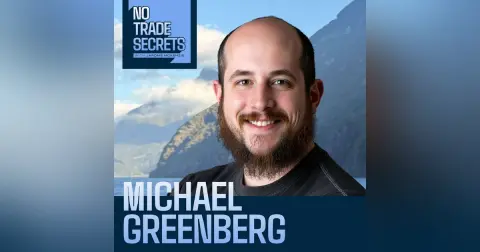
Welcome back to No Trade Secrets! We're thrilled to have AI and Operations expert Michael Greenberg back with us. In PART ONE, we laid the groundwork for leveraging automation in your business. In PART TWO, we shift from theory to execution and dive deep into the human element of entrepreneurship. How do you get your team to stop fearing AI and start embracing it as a tool for high-impact work? What happens when the financial milestones stop bringing you joy, and what truly drives a founder's...
Welcome back to No Trade Secrets! We're thrilled to have AI and Operations expert Michael Greenberg back with us. In PART ONE, we laid the groundwork for leveraging automation in your business. In PART TWO, we shift from theory to execution and dive deep into the human element of entrepreneurship. How do you get your team to stop fearing AI and start embracing it as a tool for high-impact work? What happens when the financial milestones stop bringing you joy, and what truly drives a founder's fulfillment? And what ancient wisdom holds the key to navigating the modern business world?
⏮️ Catch Up on PART ONE
💡 Unlocking the Playbook
Win Hearts and Minds Before Code: To successfully implement AI and automation, you must get your people on board before you ever touch the process or technology. Team members often resist change because they fear their "tribal knowledge" is their only job security. Michael's approach is to build trust by showing them how automation can eliminate the tedious, "copy-paste hell" parts of their job, freeing them up to focus on the high-impact, analytical work they actually enjoy.
The Happiness Plateau: For many successful entrepreneurs, there comes a point where making more money no longer moves the needle on happiness. Michael experienced this early in his journey, shifting his definition of success from financial milestones to the tangible impact he has on others. He now counts his wins not in dollars, but in the text messages and calls from people whose lives and businesses he’s helped improve.
Community is the Key to Longevity: Running a business, especially a remote one, can be isolating. Michael emphasizes that according to longevity research, in-person social relationships are the single largest indicator of life expectancy. This is why he moved back to his hometown to be closer to family, joins social clubs, and prioritizes taking significant time completely offline to foster real-world connections.
🤫 The No Trade Secret
Michael offers a two-part secret. First, for aspiring founders: don't start a business until you've worked for other people in real companies for at least five years. The best ideas come from understanding complex operations from the inside. If you can't do that, your first business should be one that gives you maximum exposure to many other businesses. Second, understand that money is just a tool. The pursuit of extreme wealth often requires doing unpleasant things, and the answers to a fulfilling life are more likely found in 2,000-year-old books than in last year's best-seller.
🗣️ Words to Build On
"We have to get the people on board before we can do the process, before we can do the technology." – Michael Greenberg
"I count my success on the text messages or the emails or the calls where they say, 'hey, you know, you really changed the way we do things.' ... I don't count it on like making money." – Michael Greenberg
"You're going to probably find the answers to life in books that are already 1,000 or 2,000 years old. You're much less likely to find them in the book published last year." – Michael Greenberg
👤 About Michael
Michael is the founder and Chief Architect of 3rd Brain Digital Operations, where he leads transformations that move clients from spreadsheet sprawl to unified workflows and automation. His work and case studies inform the book’s playbook-style guidance and give operators a shared language, and a clear path to reach Level 3 and beyond.
Author of Digital Operations Playbook: AI Readiness for SMBs, a practical roadmap that helps small and mid-sized businesses build the operational foundation needed to plug in automation and AI, without chaos. The book shows leaders exactly where they are today and what has to happen next to move from “paper to AI.”
Drawing on the book’s core frameworks, the 5 Levels of Digital Operations, the 3 Cs (Consistency → Clarity → Capacity), and the Pillars of Digital Operations, Michael translates tech trends into step-by-step execution. His approach focuses on sequencing change (people → process → tools) so teams standardize work, unify data, and then automate safely, unlocking capacity with measurable results.
🔗 Links & Resources
- Connect with Michael on LinkedIn
- Visit the 3rd Brain website
- Check out The Digital Operations Playbook: AI Readiness for SMBs on Amazon
🎧 Missed the beginning? Go back and listen to Part 1
And I think also part of it too is uh I think where a lot of resistance does come from inside of organizations is that uh, you know, back to being in that camp of that kind of scarcity camp that um I think a lot of people think that if you're gonna implement these systems and implement AI to help them in their role, you that secretly you're trying to uh automate their role and have them transition, you know, train AI or uh give up all of their you know institutional tribal knowledge that is, you know, Gary has you know he's remembers all of the things that he's not gonna write down on paper because he's not gonna give up his only leverage to keeping his job. Uh uh when in reality I I think it's kind I I think it's quite the opposite in a lot of cases that like it's you know, at least you know, like internally for us, like yes, like w I anticipate that the amount of new human roles that come up in the future is just going to become less and less. But um because but I I knew how important it was to get my entire team, no matter which area of the business they touch, to get on board with experimenting and playing with with AI and technology and and just just you know, like I use the word play a lot because that's uh because it it really is pretty fun when you play and you have a breakthrough and you create a system that uh takes something off your plate that you didn't want to do anyway. Um but uh what was super important was to make sure my team uh understood that like no, like uh this is not I'm not all my goal is not to replace you, it's to enable you to do your role at a higher quality, faster rate, and you know and uh part of it is also has what part of the outcome has been some of those lower level, more tedious parts of the role have started to be eliminated because those are the easiest to automate also. Um and so but then I so like my team uh is on board with that, but like I I just I like I see a lot of a lot of teams that like they're they almost hold on to that tribal knowledge tighter because they think that that's the only leverage they have.
SPEAKER_00Yeah.
SPEAKER_01How do you how do you approach that?
SPEAKER_00Well, that's the sitting with them part. That's why we're so adamant that we have to get the people on board before we can do the process, before we can do the technology. Because if you don't get the people on board, you don't get the complete process, you don't get the exceptions, you don't get the tribal knowledge, and then you have an incomplete process and you don't have the right data, and then you can't choose the right technology, you can't choose the right tools and you can't build them properly. And so it really is just about time and patience, and there's no real like trick to it at the end of the day. It's about making sure that people understand you're on their side and you're here to help. And do we have clients who are hiring us to automate things to reduce the size of a team? Yes. Is that the exception? Also, yes. That's you know, 10% of the clients where, oh yeah, well, we're just scaling so fast and we've built up this team, and we've just been hiring people to fill these roles, and yeah, we have somebody who just copy pastes data all day from tool to tool. Well, we can probably train that person to do something new afterwards. And uh, you know, it's about sitting down and having that honest conversation where you're like, look, you spend half your day copying things from Excel to Google Sheets or to the CRM. That's gotta be boring as all heck. And they're like, Yeah, you know, it is, but it's my job. Somebody's gotta do it. And we say, well, what if I showed you how you could do that job? And you could do the other 20% where you're doing the analysis and you're writing the reports that you enjoy creating, and where you create real impact in the business. What if we could help you get out of that copy-paste hell and get into the other work? And they have to trust you enough to do that. That doesn't happen in just a day. That doesn't happen in a single sprint in a week. That doesn't happen when their boss says, you have to meet with so-and-so every week to make sure you do AI. It happens in Slack channels and it happens in these little additional side meetings, and it happens in the hey, uh you're going out of town next week. Let's set up an automation to replace one of your copy pastes and make sure that you can relax when you're actually on vacation. Oh, you love playing golf with your clients. Let's make sure that you don't have to come back to the office on Fridays to log everything in your CRM so that way you can go do 18 holes every Friday with your biggest clients and double your accounts next year. And so it's very much understanding how they get rewarded for their work and understanding what drives them so that way you can find the match that supports them effectively.
SPEAKER_01No, I love that. Um, yeah, you you have to find out you have to find out uh what their you know what their what their love language is inside the workplace, right? It's uh and it's different for everyone. Um and you know, you you talk about what drives them. Well you know, you're a multiple-time founder entrepreneur, you've worn a lot of hats over your career. Um what drives you?
SPEAKER_00I enjoy playing the game. So, like I I you know, I do business because I enjoy doing business. Uh I enjoy the work I do now helping people with AI and with automation with their operations because I see the relief it creates in them, how their lives become better from it. If somebody said, hey Michael, we've got a PE firm, come do the same thing internally. If the comp package was right, I'd probably go do it there. Being an entrepreneur is I became an entrepreneur because it was the best way to make money at the time. And I stuck with it because it's very hard to get hired after you've been an entrepreneur for five, ten years. Um, but fundamentally, I do the work I do because I enjoy doing that work. And I I joke with my team like AI is gonna replace us all one day, so you better learn how to make video games, or you better enjoy making games or other things like that, because that's not gonna be fully automated. And or I'll say, you know, well, it's a good thing I know how to butcher a hog. Uh because worst case scenario, I can always go open that shop. But fundamentally, I think what drives me is I enjoy seeing people enjoy what I create. And that can be a really great pork roast, or that can be a new internal tool, or that can be the operating system for a $20 million roll-up that's going to go to $100 million and then get sold to a larger private equity group or holding company. And I count my success on the text messages or the emails or the calls where they say, hey, you know, you really changed the way we do things. You really changed my life here. Um I don't count it on like making money. Uh I don't think that's really a valuable thing.
SPEAKER_01Um you founded your first company.
SPEAKER_0022.
SPEAKER_01Is it uh is the assumption correct that uh when you you know you said like uh uh you mentioned that that was the best way to make money at the time. And I think you know uh I think a lot of entrepreneurs go through this uh kind of cycle, uh, you know, growth cycle, this realization uh of uh, you know, like for you, and you know, it's like, oh, this is the best way to make money at the time. And I think, you know, like for me, it was like, yeah, this is a way that I can uh in theory, if I if I wanted to make I could make double what I'm making right now my salary job and work a quarter of the amount of time. Like that math equation make made sense, but it was pretty quick into my journey, uh, you know, uh, you know, a couple of months in, you know, growing and like each financial milestone like did give uh you know give a real uh you know give you a high, right? And then but over time, pretty quickly that started to wear off, and the high was less and less, and then uh it there was you know it it shifted completely into that realm that you're talking about where you get your fulfillment, which is the same where I get my fulfillment, uh, and how I measure success is the same. And I know a lot of a lot of founders and uh entrepreneurs that I'm friends with also uh get their fulfillment this from like the same place. Um when did you go through that transition? Uh, because obviously, you know, it's you know it's not it's not about the money, but you have to make money, right? Uh yeah. When when did you go through that shift?
SPEAKER_00Like 22? Yeah, so early on, right? Like well, before I founded my first business. So like I had always been kind of a hustler. Uh so I I was making money, I was selling things on the side, and I I'd gone to a coding boot camp, and that was when I was like 2021. I went to a coding boot camp, and I realized I didn't really enjoy coding enough to go do that all day, even though that would clearly be the best way for me to make money. Uh the developers were in very high demand. I could have gotten a 90,000, 100,000 a year job. This would have been like 10, 15 years ago now, and maybe close to 10. Um, I'm not great with not great with tracking time. And I had dropped out of school, I could become a developer, I could make a bunch of money, and I was like, yeah, I don't think I'm gonna do that. So I went back to school and I started doing some consulting, and then I started my business, and I was like, okay, yeah, this is working. And so I was making money while I was in school, and then I grew that business, and I eventually sold most of it to somebody else. Um, and throughout sort of the entire process, I realized very early on, because I had taken a year off uh when I left a startup before I went back to school and started this business. I sort of looked inwards and I was like, okay, why am I doing this stuff? Why why do I even want to do any of this? What do I want to do with my life? I could go into real estate, I could go into these other things. Um I was like, okay, well, I guess I'll start a business and I'll just see where that goes. And then I was like, ah, this was pretty fun. Uh, maybe I'll keep doing this. And then I got to that sort of plateau where I'm making a few hundred thousand a year and I'm in my early mid-20s now, and I don't have to work very hard to make that money because I put in the time when I was younger, and I got to take a little time off, and I got to play around and hang out. And that was a lot of fun. And I got more control, more freedom over my life in the process. And then I realized, like, oh, you know, this is all right. And then I got the first one of those messages where somebody was like, hey, you know, somebody, uh GM who had worked for me as uh like a general manager, he was like, Hey, you know, you changed my life. Now I'm doing this other stuff. And I was like, oh, well, that felt pretty good. Let's see if I can do that again. Uh, and so kept working, kept working, got a few more of those. I was like, okay, these feel pretty good. And then now as I've gotten a little older, I've realized like they don't mean as much when they're all all around the world, when it's just people you know online. Even if like I know fundamentally I've changed some of these people's lives, it just doesn't mean as much to me if I don't see them in my yard, if I don't have them part of my community. And I read into longevity research and it was fairly clear at that point, and I think it's been finalized now, that like in-person social relationships are the single largest indicator of life expectancy. And so I'm like, okay, well, I should really focus on doing some more of this in person. And I haven't really done that yet. I should be clear. I have not really made the moves to in-person as much as I would like. Um, but I started to take steps in that direction. And at least going back to your actual question, like it changed for me because I realized that making more money did not make me happier. And I had read that in the books, but it's not until you experience it that you realize it. And I think the reason that happens for entrepreneurs so much faster is because, at least for those who find any sort of modicum of success as an entrepreneur, you know, I'm not, I I do not have tens of millions of dollars yet. I don't have hundreds of millions of dollars. Uh I'd like to someday, but it won't really matter if I don't get there either. Um, but when you go from making nothing to making something, and then you go to making something more, and maybe you're doing better than somebody else, maybe not. It doesn't really matter if you're really taking the time to understand yourself and how people become happy, but you go through that progression faster. You're not waiting for that next promotion in two years and five years to get that big jump. And so you can go through that progression of income growth faster and you more quickly realize, like, oh, this just doesn't move the needle for happiness in the way you thought it would. And then you start looking for something else.
SPEAKER_01Yeah, well, and what was you know, it's uh you know, I think uh you know, you you've uh you've had multiple different seasons of your entrepreneurial journey. Um and you s you you always uh uh clearly uh start back. Let's do something else, something new. Um what you know, especially what I guess first my first thing I want to know, what was your f what was your very first business? And I'm talking, you know, the what was your version of the and maybe it was the uh you know mowing your neighborhood's yards, or for me it was uh selling uh cans of Coca-Cola at high school uh that I'd carry around in a duffel bag on ice, like that was my first, you know, you know, business, not business. What was yours?
SPEAKER_00I mean, I I guess it probably was like selling lemonade and shoveling snow, raking leaves. But the first one that really made some money was um was sort of a two-parter. We sold candy in high school. And I I also ran like a little casino out of my uh academic hall, my my study hall. And my my whole school had it at the same time, and so that made it very easy to like run. And I was like, wow, casinos make good money, um, and you can't lose money running one, which was a big plus. And so that that combined with candy sales were probably the first two more serious ones.
SPEAKER_01And uh did the casino did that get shut down, or did you move on to something else?
SPEAKER_00The candy got shut down.
SPEAKER_01The candy got shut down, but not the casino.
SPEAKER_00Yeah, they thought we were so like the candy we were doing for a youth group, uh, and I sort of went against the rules in that I incentivized my salespeople. Um, so I let them take some of the money. And so we we were making something like $800 a week, uh, which was a lot for one of those fundraisers, and they thought we were selling drugs, and so they they sort of they shut us down. Um we weren't selling drugs, uh, but I mean we were selling sugar, so not that far apart. Uh we definitely had regular customers, and we were just implementing the you know standard business tactics. We would have uh somebody with a a briefcase of candy at every major intersection inside the school, and we'd have a oh, you buy five, buy ten, you get one free. If we had product that wasn't moving, we'd do sales on it, that sort of stuff. And so um, like we just moved a lot of candy very quickly uh across several schools, and then that got flagged. And we continued selling candy individually after that, uh, but just not through the youth group.
SPEAKER_01Well, that's uh and how did the casino not get shut down? Didn't get caught. Didn't get well.
SPEAKER_00I feel like uh also very permissive schooling. Uh like I I think if they they saw us playing poker, but they didn't see the money under the table.
SPEAKER_01Gotcha. I feel like uh I feel like that would have been uh something uh at my school that would have been shut down like within a week because it would have it would have caught fire so so quickly, and then there would I I'm just I'm just I'm shocked that there was uh there was not a single person to open their mouth to the to the wrong person.
SPEAKER_00Well, I I just don't think they cared. I'm sure like you know, the teacher in charge, well, we had the drama teacher was our like person in charge, and she just wasn't there most of the time. And uh we didn't have like any snitches in our particular class, and you don't need that many customers to keep something like that running. Um the candy was much more profitable, I should say, but the the casino did all right.
SPEAKER_01Hmm. And then what was your first uh uh official business? It was an it was an agency, right?
SPEAKER_00Yeah, so it started as me just sort of doing some digital consulting, some like web work, that sort of stuff, and then it ended up being a podcasting agency. Um, so we did B2B podcasting primarily, and we really found success with white label podcasting. So white labeling to mostly local digital agencies who would then set up local podcasts for lead gen or for SEO. And I tried to do like B2B content marketing. We got a few clients, we did all right there, but we just never got the same traction that we did with white label, it had stronger product market fit, and so ultimately I ended up selling that white label side of the business uh to one of our larger clients because they were a white label agency themselves.
SPEAKER_01Gotcha. And so outside like what is you know, this is something that I've been uh really uh kind of experiencing recently is uh the need to have for me to have something outside of the business, right? Because especially when you enjoy especially when you know when you enjoy growing your your business, it like it doesn't feel like work the same way that it uh work feels like to you know a lot of my friends. But then I I I I was aware of uh the need to have something outside of it. Uh um that I enjoyed doing equally as much uh if possible. Do you have and like I found that recently uh uh you know a year or so ago uh with golf um and it just so happens to also be um uh you know a great place to to meet people that uh also help uh help b help business and are good people to know for business to introduce to clients or potential clients you know like it's yeah so I I don't think you did a great job with that assignment I'm not gonna not gonna lie I feel like I did the most business oriented sport fell in love with it yeah yeah it's but I mean the something that you said earlier that really um that it made me think of uh of the golf uh and like part of my life now is is when you sit when you're talking about in-person and community and longevity and um I was like especially running a remote business um like I didn't realize until I started going out and meeting strangers and being in person for four hours or over a round of golf getting to know a complete stranger um how much like I've deprived myself of like a lot of in-person human interaction apart from my wife and my dogs and my immediate family and friends. And it's been like a breath of fresh air to be able to do that and like I've I've felt better just overall uh my energy like is higher um and I feel like uh I I'm enjoying you know I enjoy life more than I already did um and so that's what golf uh you know and what you talked about earlier made me think about what what's your what's your outside of business thing then it is it it's not golf I'm assuming but it's not uh though I I haven't I don't think I've played golf in 15 years.
SPEAKER_00I learned when I was a kid and I just never stuck with it. But I well I have a dog and I do have friends. I go out to happy hour going out to happy hour later this week um I cook quite a bit and so that's sort of my my passion outside of it. I also take a lot of time offline uh I try to you know walk every day I try to take at least 24 48 hours offline entirely every week no digital no social anything like that um I moved back to my hometown of St. Louis so I could spend more time with my family uh and that I I've been very happy with that and then I I'm a member of a a social club in in the city and so that's one I'm not as involved as I was in the past and I'm working on getting more involved again now uh and I used to be involved in some boards locally as well uh before I moved away and now I've moved back and so I I think it's a mixture of like at least for me the the social club and my personal network and then now I'll I'll probably join some sort of board uh for a nonprofit again in the next year or two uh for similar reasons that's cool no it's um move what what what drove your decision to to move back to uh St.
SPEAKER_01Louis Missouri Oh family absolutely um and why did you move away in the first place uh work and enjoyment we're we're so I I moved yeah we're I moved to the yeah I moved to the Bay Area initially to go to a coding boot camp um and then I moved for work with a startup uh down to the southeast uh first to South Carolina and then over to Chattanooga and then I stayed in Chattanooga after I left that startup and moved back to St.
SPEAKER_00Louis to go back to school for a few years and then when I I graduated uh when I went back to school for the second time I moved out to Denver um and I stayed there for a number of years and then I was like yeah Denver's pretty nice I I like it here maybe I'll move back here again in the future but um my family my parents are getting older and I'd like to spend more time with them um and so I I moved back home and we we get you know dinner once a week together now.
SPEAKER_01That's awesome. Um yeah it's uh no I went I went back to New Zealand uh took my wife uh back in uh March of this year and it's the first time I'd gone back in eight years. Um wow and I didn't realize how much of a routine you get I got into just talking to my dad on FaceTime you know almost every day for the last eight years. And we've always been very close. Um and we I went back and then it was like it was it was almost weird when you know the first couple of days being around him in person and then I like I we left that trip. You know we were there for ten days so it wasn't long at all but I left and I was like man like I already didn't think money material things were like really that important to begin with. But after this trip I'm like I would have paid uh there you know there wasn't a a number you could assign to how much I would have paid for one more day you know to spend with my dad upon leaving and uh were it completely shifted added a new goal like to my life and my why every day is like okay like I wanna uh I want to be able to retire my dad and move him over here so he can uh he can be around uh our kids when we have kids and and be a grandpa here. Like and I didn't quite realize like the magnitude of my decision to leave uh kind of randomly um eight years uh well I left nine years ago but um and and I was it it's really a lot of reflection the last couple of month uh months after that trip uh on like um which I'm sure like is something you you know you experienced uh of like time is the one thing that you just you don't get back and it like you know especially time with your parents and any loved ones that um and it's how valuable that is and and um you know really kind of what is important in life uh so I'm really happy you moved back and you get to be closer to your parents um because it just that's a a recent a recent experience for me that uh kind of similar with that yeah I I think at least for me personally I didn't really expect to be alive into my 30s uh I was a bit of a wild kid when I I was younger and I I had some friends who passed away fairly early on and so I was like yeah you know I don't I don't know about 35 year old Michael is that guy gonna exist uh so I sort of look at everything now as very much bonus time and I I've met a few people who have had like real near death experiences and that sort of thing and it seems to be a a consistent theme that uh you know on once you've had that real until you understand that deeply and in many cases you have to understand it intimately uh it is difficult to understand how valuable time ends up being yeah no absolutely it's um it's I mean it's the it's the only thing that doesn't matter how much money you have or how much power you have in the world uh that you can't you can't buy more of you can't get more of not according to the propaganda the AI singularity longevity guys they're they say right you make enough money you're gonna be able to live forever uh I think that's roll in a simulation and and you make more money you can just buy more buy more tokens buy more credits and uh to buy more more time for your simulation I guess who knows and I I think that's total BS uh I think that's just propaganda to make us work harder so that way they uh get more money from our hard work uh and it all trickles up yeah well um I I've been ending each of these episodes with a question to uh same question every every guest and uh so I'm gonna ask you the question too is what what is your one trade secret that you don't believe should be a secret anymore that people should know and that can apply to business to life uh trade secret in this case is is my trade like AI or is my trade entrepreneurship more uh think of it more like like what is your uh you know what is your own experience of the the secret to happiness for you or secret to a good life or like the like the one thing like if you if you were to give uh a young person particularly going into an entrepreneurial journey uh one piece of advice like business or life what like what would that be like what's been your one secret can can I give two absolutely so I I think for the for the young guy who's going into entrepreneurship um if you haven't spent five years for working working for like other people in real companies don't go start a business go understand how companies work because your the best business ideas tend to come from people who have like direct experience working inside of complex operations because they have bigger problems that they understand on how to solve um and if you can't do that for some reason or another then start a business that gives you exposure to those things.
SPEAKER_00And so I think sort of the the hack there is that your first business is probably not your last business and if you don't know what business you should start your first business should be one that lets you get exposure to many others. And then on the on the maybe more general side uh money is a tool and in general it is my experience that people who have north uh most people I've met who are in the hundreds of millions net worth are unpleasant or unhappy and that that like that is very much a stereotype and it is very much true. And the reason for that is that the ways in which you make that much money are fundamentally and generally unpleasant things to do. And so I think it is worth understanding that there are many very pleasant ways to make a living and to have a comfortable life even in the pressures and the stagnation or inflation and cost of living crisis and all that stuff of today and you don't need to make you know I I was blessed to do fairly well fairly early on uh but you don't need to make a million dollars tomorrow. You don't need to make million you probably do need to make a million dollars over your lifetime these days uh to have like a fairly comfortable life but you don't need to make a million dollars in a day or in a year in most cases. And same goes for 10 million. And so I I think if you spend a lot of time on social media and uh you brought this up where X and LinkedIn are sort of throwing these things at you you need to spend more time off of it. And you're going to probably find the answers to life in books that are already a thousand or two thousand years old uh you're much less likely to find them in the book published last year.
SPEAKER_01I love that book. Not audio books no not audio you need the physical thing what's uh I'm gonna cheat and ask you one more question uh because I love reading books especially like that um my favorite is uh one of my favorite books of all time is uh called the Master Key System and it's older than think and grow rich so it's like a hundred and whatever years old um check it out what is what's your what's your what's what's your favorite book of you know of that we'll call it we'll group it in a category of ancient wisdom so I I I don't know if uh I'm looking at the Master Key now 1912 I don't think that's quite old enough uh I'm sure it's a great book but I I'm a big fan of the writings of Seneca um and Epictetus and Marcus Aurelius is great but most of us are never going to lead an empire.
SPEAKER_00Seneca I think the letters from a Stoic in particular is one that I go back to um but again like he was quite successful and so a lot of it doesn't necessarily always transfer as well. Epictetus was a slave though uh so he he has a little more of a grounded approach uh obviously like uh traditional religious wisdom is often quite valuable today still um and then uh in the modern book category I've I've got up here skin in the game uh Nasim Niklis Taleb uh and this is a fantastic book and it's great for business it's great for life in general um because so much of our life is built on these sort of information asymmetries or these unbalanced risk scenarios that you don't even realize are happening.
SPEAKER_01And understanding incentive alignment and the way people operate in the world is something that exists across centuries I'm writing down skin in the game right now uh I'm gonna bump that up up the queue to my as my next book. Thank you. Excellent well Michael thank you so much man I've really enjoyed uh uh our conversation um and yeah uh what's the best I'll put the links in the show notes but what is uh if someone wants to see what you are up to what you're building what you're talking about or get in touch with you what's what's the uh what are the best ways to do that yeah so you can find my my personal stuff at gentoftech.com or gentof.tech and then the third brain the the business I run is at uh number three r d b r a i n dot co um and that that's uh probably a little out of date when you see this uh because it almost always is we're working with clients more than we are working on marketing but that's uh that's where you can reach out if you want to talk AI. Awesome well thank you so much Michael um really appreciate you uh you coming on yeah thanks for having me