Why Your Best Ideas Happen Outside of Work w/ Michael Casciello (Part 2) - Ep. 46
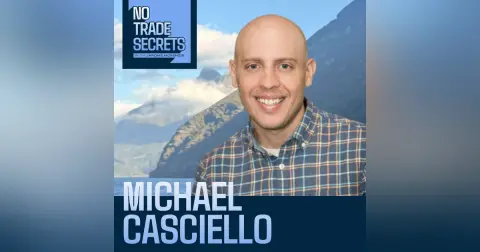

Welcome back to No Trade Secrets! We're thrilled to have entrepreneur Michael C. back in the studio. In PART ONE, Michael laid the foundation of his private chef empire, detailing the "why" behind his vision. In PART TWO, we shift from the 'why' to the 'how.' How do you scale a high-touch, intimate service business without losing its soul to technology? What’s the counterintuitive secret to generating your best ideas (hint: it has nothing to do with working more)? And how do you find the cour...
Welcome back to No Trade Secrets! We're thrilled to have entrepreneur Michael C. back in the studio. In PART ONE, Michael laid the foundation of his private chef empire, detailing the "why" behind his vision. In PART TWO, we shift from the 'why' to the 'how.' How do you scale a high-touch, intimate service business without losing its soul to technology? What’s the counterintuitive secret to generating your best ideas (hint: it has nothing to do with working more)? And how do you find the courage to take a terrifying, bet-the-farm risk that could change everything?
⏮️ Catch Up on PART ONE
💡 Unlocking the Playbook
Draft Behind the Tech Giants: Instead of spending millions on user research, Michael studies how industry leaders like Airbnb, Apple, and Amazon design their user experiences. By observing how they solve common problems—from button colors to booking flows—he can adopt proven design patterns and meet customer expectations without reinventing the wheel. This allows his small team to leverage big-company data to build a user-friendly platform efficiently.
Schedule Your “Aha!” Moments: Michael actively rejects toxic hustle culture, arguing that your best ideas emerge when you’re not working. He’s learned that stepping away from the computer to walk his dog or have dinner with friends is when his most creative solutions appear. By intentionally building downtime into his life, he returns to work more excited, focused, and innovative, preventing the burnout that plagues so many founders.
Protect Your Time with Graceful Exits: Early in his journey, Michael took every meeting and entertained every idea, quickly getting bogged down. Now, a key part of his job is culling the unproductive. If a meeting isn't proving valuable within the first 10 minutes, he politely ends it, recognizing that his time and energy are his most finite resources.
🤫 The No Trade Secret
Just Go For It. Early on, Michael was quoted $30,000 to build the website that would become his business—a sum that felt like $5 million at the time. The very next day, a pre-qualified loan offer for that exact amount arrived in the mail. Seeing it as a sign, he made the terrifying decision to take the loan and bet on himself. That single, gut-wrenching choice was the crossroads that made everything else possible. The secret isn't waiting for the perfect moment; it's recognizing a pivotal opportunity and having the courage to take the leap.
🗣️ Words to Build On
"Most of those ideas that I had were when I wasn't working. I'm walking the dog, I'm at a dinner with a friend, and we're just sort of discussing life. Those are really when I have my best ideas." – Michael C
"The house is on fire, what can I possibly do by being there? Because I'm not." – Michael C
"I couldn't be happier that the old me made that call when he did." – Michael C
👤 About Michael
Michael Casciello is the co-owner and founder of FOOD FIRE + KNIVES and a classically trained chef whose culinary journey began at just 14 years old at a local produce stand in New Jersey. He soon moved into restaurant kitchens, starting as a dishwasher before working his way up to the fryers and eventually creating his own specials. He later studied restaurant management at Walnut Hill College and trained at the Culinary Institute of America alongside certified master chefs. After experiencing the long hours and limited freedom of the traditional restaurant industry, Michael set out to build something different. From Charleston, he began bringing fine dining directly into private homes, combining food, education, and entertainment while creating a more flexible path for chefs. That vision became FOOD FIRE + KNIVES.
🔗 Links & Resources
🎧 Missed the beginning? Go back and listen to Part 1
So our our vision for the company right now is to um to just bring bring on more chefs, uh get more business, grow into uh different countries. Uh we're looking at Canada next, uh we'll go into uh the UK, uh, and we'll grow as fast as as fast as we can handle it. Uh we have our our foot on the you know on the pedal, it's it's maxed out. Uh we want to grow as quickly as possible. Uh as far as technology, um we you know we we get emails every single day about uh growing with growing with AI and growing with this technology platform and that technology platform. And so uh as I mentioned, we're just we're so super selective uh in choosing any sort of like technology, especially a third-party technology uh that claims it's gonna grow us, that is gonna remove us from that um that intimate uh you know interaction with our customer uh clientele. And so yeah, our our plan right now is to just optimize the website. How can we make it better for chefs? How can we make your life better? How can we make it easier for the customer to book uh to choose their perfect chef, to choose their perfect event, to choose their perfect entrees? Uh so right now it's it's really the details, uh, nailing down the details uh and then scaling from there once it's really perfect.
SPEAKER_00What's the what's the biggest thing uh that you need to figure out or overcome to be able to do that? Is there a specific area uh for worth where you're at now?
SPEAKER_01I think the the the biggest area honestly is the the changing of um uh of technology um and design and what uh what customers expect, right? So when when they use you know what Airbnb was a a massive uh change to the online uh booking industry, right? Now you could actually search for a home to rent and like you're you're living in someone else's house for two days, three days, a week, whatever. Uh I just remember that being so odd. Uh Uber was uh really, really odd when it came out. Like you're getting picked up in someone else's car, and like what what is this? Uh do you have to tip? Uh what's gonna happen? Like, is their car clean? There was just so many like unanswered questions, but once it becomes the norm, uh that's when you I mean you don't think twice about it, and that's really what we're getting to is like we want to learn customers' expectations. Uh, what what what do they expect when they hire a chef? What does it mean when they bring someone into their home? Are they expecting uh servers? Are they expecting us to talk to them and uh which which we love to do, we love to interact with the customers. Uh do they just want to sort of leave us in the kitchen and just you know have us serve them? So we're we're constantly learning like what people expect, not only when they get to the house, but what do they expect when they're on a website? Like it, you know, if I book a chef through the website, are they actually gonna call me and show up? Am I getting scammed? Uh so we sort of rely on right now a lot of other technologies that are out there and what other people are using and how it's becoming the norm for them to interact and use those services, and then we sort of like follow suit, right? So we don't want to get left behind. Uh, and I think we're too small right now to sort of be a pioneer in something. So we can't introduce this new technology where someone books online with their uh their eyes or something, right? Like there's no retina scan, like it just it's not gonna work, right? So uh keeping up with that technology uh and expectations uh is sort of the the day-to-day for us. Uh there's different designs. You see Apple every day or every new release to their iOS releases some sort of like new design now, it's like this glass thing where you can see through it. Uh obviously, I don't think we'll ever do that. Um, but it's always like this skeworphosism and this flat design, then it goes to this, and it goes to that. So keeping up with that is uh exhausting enough. Um but uh going through the entire uh where do your eyes look when you're looking to click a button and what color should it be? And you see all these studies done with you know Amazon and Wayfair and all these big companies. Um we utilize them because hey, they have the money to spend on the data and then they present the data. Uh it's sort of like you know, uh Burger King using McDonald's, right? They would they wouldn't do all their market research, but then they would just open up across the street from McDonald's because they spend all the money uh figuring out where you know the to maximize uh sales and profit, right? So we sort of do the same right now, um, and we uh very closely follow like an Airbnb model because if people are booking Airbnbs, it's it's not too foreign to them. Um so that's sort of like the direction and and sort of like where we take the company and what we think of every single day, um, and you know how to how to be more efficient.
SPEAKER_00Yeah, I mean I remember yeah. The Airbnb model and the Uber model uh once upon a time were uh a crazy concept. Uh and now it's uh I know I know people who uh uh as another one, Uber Eats. I know some uh I know someone who eats every meal uh of their life uh through Uber Eats. And that's something that used to be that's something that used to be a wow concept, or you know, running someone's house that their some of their belongings might be in it. It's uh used to be weird, and now it's uh Airbnb. Staying in an Airbnb is uh and for me at least like more enjoyable than staying in a in a hotel. Uh because you have your own you're you have your own space. Um and so um and then outside of outside of this business, uh no I know that you you said you want to grow this thing and you want to take this global and to different countries and bring on more and more chefs and build the community. Um then you obviously mental health is something that is big to you, uh, especially um when it comes to burnout in your industry uh specifically. What what do what does your life look like outside of the business and how do you manage that for yourself?
SPEAKER_01Yeah, so I this is one of the things that I I I I try and drill into uh some of our employees, and uh this is something that I've really had to learn. Um, you know, I I getting into entrepreneurship and and opening your own business, you almost have no choice but to be consumed uh 24-7. You have the uh you know Monday is the best day you've ever had, and then Tuesday is the worst day you've ever had, and it's just a constant roller coaster of ups and downs and uh sideways, and a lot of times you just you know you have to step back and you have to like you have to learn how to step back and to not sometimes not be so nice and take every single meeting. Uh, and you know, is this meeting helpful? Is it gonna be because when you when you first you probably know this too, when you when you first launch a business, you want to talk to everybody because everybody's got a new idea for you, or a new product, or a new way to look at this, uh, you know, subscribe to this, uh, Yelp ads, uh advertise here, advertise there. And so you just get so bogged down with uh everything. Like everybody wants to talk to you. There's so much to do, and uh you think that that's really the way and you and you hear all these uh these uh lunatics talk about uh you know you need to work uh 28 hours a day, and you can never put your down your computer, and if you're not working eight days a week, and and it's just it's absolutely insane. And although I agree that you do need to work a lot in the beginning, you need to one of those jobs that you have in the beginning is to learn how to dwindle down the the load. And so, you know, it's not just like how do we advertise best on Google? Uh, you know, your your second job of the day is how do I wind this down where I can either pass this off to somebody else uh or cut it from my my schedule entirely. And so I feel like over the course of you know uh several years I've been getting better and better at that. But you know, if if I do take a meeting and you know, 10 minutes in uh an hour-long meeting, I decide this just isn't right for me. I'm not gonna be the nice guy and stay on the meeting. I'm just gonna end it and politely uh you know, uh and end the meeting. Uh I'm sorry, this isn't right for me. You know, uh I wish you luck or you know, whatever it is, right? Um, but there's there's just a lot of people that will will literally take every meeting and will literally stay on the entire meeting. And I'm just like, oh my goodness, like that is my worst nightmare today. Uh so you know, I I still work long days. Uh yesterday I worked uh from 8 30 a.m. to about uh 1.30, 1.45 in the morning. Uh I took the dog for a walk. You know, I ate some lunch, but um, other than that, I was on my computer, my computer with me all day. Um so there are still days like that when things need to get done. Um, but you really have to learn to step back and enjoy yourself because most of the decisions I've made, or you know, if it's a new uh product uh or a new technology or automation, design feature, what it is, whatever it is, new way of doing something, most of those ideas that I had were when I was when I wasn't working. You know, I'm I'm I'm walking the dog, I'm I'm at a uh a dinner with a friend, and we're just sort of discussing life. Um, those are really when I have my best ideas. And then when you you know, when you get back to work, that's when you sort of like hash it out and say, okay, how can I make this idea better? Um so I feel like you know, most of the time when I'm working, that sort of creative aspect I'm having, which is the best part of my job, is is being creative. Um I I don't have that as much because I'm I'm trying to nail down the day-to-day and the mundane tasks and the numbers and things like that. So um stepping back and enjoying my my life and my my girlfriend and my house, and you know, um it's it's worked wonders for me.
SPEAKER_00Yeah, no, you you you said something that I uh I learned and completely agree with as well. Uh that some of my best inspirations uh inside my business came um on vacation with my wife. Um and the amount of the amount of added fuel that I would then return home with when going into a vacation, uh, especially in the early uh in the first phases of the business. Uh I would go into these vacations with like very anxious and stressed about not all in my in my office, in my setup, working all day. Um and then I realized, yeah, just all these different breakthroughs that I would have during these trips. And I'd come back refreshed and with ideas that I wouldn't have gotten if I was so zoomed in on whatever the thing was that I was doing. Because I I feel like when you take a step out and you uh uh you feed your soul with the other things that you need to live a life that you enjoy, um that's when those both things kinda that the you know for me it's like kind of call it like I get into this like that flow state um and things you start zoom, you you know, step back and you zoom out and you can see things from a different perspective. Um and those are the most beneficial um beneficial times that have led to some of the the best innovations in uh in in in our business.
SPEAKER_01Um Yeah, I think even when things go wrong, right? It's like you know, you're you're on vacation and then something happens, right? I think also saying to yourself, like, what can I possibly do? You know, is there something I could do by being there or you know, hopping on my computer? If not, then I I have I've hired the people that I trust to handle the the whatever is happening, uh, if the website is down or you know, what whatever happened, right? Um I I think that's also you know something that I had to learn was like, oh my goodness, the website's down. I'm gonna have to be on my computer, and then I'm on my computer just looking at my computer. There's no, I'm not a I don't develop code. I can't, you know, I I don't have uh I can't tell Amazon uh not to get hacked or you know, whatever it is, right? Uh through AWS. Um but um yeah, it's a lot of times it's like, okay, what can I possibly do by being at my computer if something happens? Uh and that's another thing that I I learned that one a long time ago. Um I was working in a restaurant and um it was my off day, and the kitchen caught on fire, uh the a pizza hood caught on fire, and I I obviously everyone got evacuated, and you know, the fire engines are coming, you know, pouring water on it. And I just I remember getting a call from my uh my general manager, and he was like, Hey, we need you here. And I was I was uh at the Jersey Shore about you know uh an hour and a half away, and um I just remember saying, like, what what can I possibly do? I mean, I understand like this is a catastrophe, right? But like me being there, I I cannot fight fires. I'm not trained to do that. I don't know what else you want me to do. Uh there's no you know, switch that only I could flick, you know. So um after explaining that, he's like, Yeah, I mean, I guess you're right, you don't need to be here. Um, but once everything's sort of settled down, it'd be nice if you could be here. And I said, Absolutely, you know, we'll have to get all of the items, you know, the refrigerated and frozen items out of the walk-in coolers and you know, all that kind of stuff. But uh, you know, long story short, that that's sort of like what I always go back to is like what the house is on fire, you know, I'm what can I possibly do by being there uh because I'm not, you know? Um so yeah.
SPEAKER_00Yeah, and being away also uh can highlight where you need to focus within your business, because uh, if you remove yourself for you know a few days or a week, um then you're gonna find out what's what's broken or what what is susceptible to breaking. Uh and then you uh because there's a lot of things I think a founder holds together and that you never know are are broken systems um until the founder leaves and then they have to let go to go somewhere else and then you see what falls and then you're like, okay, that's uh and that's valuable information. Uh um but yeah, it's most things, you know, I um I've always uh said, you know, to anyone on my team, you know, because you know it's easy to to get in that kind of panic mode if you know something if something goes wrong or um um or something uh not ideal is happening. And it's like I always ask myself, okay, first of all, what are the stakes? Is did anyone die? No. Because we work in finance and accounting, consulting, no one, no one should die. And no one did die. No one's ever died on my watch from from the work we do. And then and then uh you know, then asking, okay, are we are we saving lives here? Like are we are we working miracles and feeding uh feeding starving children and uh and doing open heart surgery? Uh no. Okay, so like at the end of the day, whatever is whatever we're perceiving to be this big thing right now in hindsight is is not that big of a thing. So now and it's it always helps us us as a team then it'll be like, okay, yeah. Um it's really not that deep. And then helps you think more. Yeah, and it helps you think more clearly, and then be like, oh, okay. Then the solution, what we need to do is easy. Uh it's just it's just simply this. Um but no, the um definitely the slipping away uh has been one of the um definitely one of the most beneficial things for me. Um and because that hustle culture is uh uh can be toxic, you know, but and because the social media, you know, all the social media uh accounts out there that just advertise this hustle culture and uh make you know make you feel like, well, you're a real piece of shit if you're not working uh every day of the week uh you know, 16 hour days uh for years and years on end. Um but it's like it all comes down to one like what's important to you in life, you know, like you I think a lot of founders for really forget why they start uh they go down this entrepreneur journey in the first place. And a lot, you know, for a lot of people that's that they're they've been working way too hard for way too little, for way too long. And so changing just the f for way too little part is not you know, that's not the the full uh the entire reason for you know that people want to be entrepreneur. It's it's whatever what is your uh definition and each person's is going to be different. What's each per entrepreneur's personal definition to them of what freedom is? And it could be the freedom to choose. The freedom uh to do what you want. It's and you know that's really what it comes down to for uh for me, and it's it's freedom for our family, and and that freedom doesn't it can look like a lot of different things, but it's um um but then making sure that you don't get away from the real reason that you you sit out on this and lose yourself in the process just because hustle culture tells you you should work and uh work until you d you you drop dead, you know, because uh Morgan Housel uh said it um best is what good is a mansion if you've got no one to share it with. And it's like yeah, it's just I think that's more depressing than than a a bungalow with no one to share with, you know.
SPEAKER_01Right, right. Yeah, I I agree with that uh wholeheartedly. You know, it's it's I I love work and I'm sure you do too. Um I I think most entrepreneurs love work, and I I love yearning for like to get back on my computer and you know, we we just uh launched a new uh service or a new design or you know, something's new with your website. Like I can't wait to wake up the next day and hop on my computer and see how it's working and how customers are interacting with it. But if I'm just on my computer all day, every day, it's just it's all the same and there's just no excitement anymore. Um so you know, if you love work, I think the best thing you could do for yourself is to step back and like get excited about it again in the next you know, two hours or three hours or whatever, take the dog for a walk and just say, I can't wait to get back to my computer, right? Um, and that's sort of like what keeps me going. I love my business, I love my employees, I love my chefs, the the contractors are great, uh, our development team is great. Like, there's not one thing I would change uh about what we have going on. Um, and I love being able to step away. And being excited to come back.
SPEAKER_00Yeah. No. I completely agree with that. I realized that um when my wife and I were on a trip, um um I think this was maybe the beginning of the year. And I said 'cause I feel like uh we've always whenever we have gone on trips just because in the past they were they were uh there was more time between each one. Um that at least I was uh I think we both in most cases would be would be by the last day we were ready to go home. And I was like, wouldn't it be way wouldn't it be better if instead we left each tri like we went on more three-day weekend trips to different places and took more trips that were shorter and then we left wishing we had one more day, so then we're excited to go back again. Uh and then I found and and then I found that that that applies uh in business too, and it's like, man, if I'm working on something exciting and I say, like this afternoon, Tuesday, I uh go and I play in this golf league. Um so this afternoon I'm gonna leave earlier than I would usually and I'm gonna go play in this golf league for a couple hours. And every time I every Tuesday afternoon when it's time to leave, I'm in the middle of work and something, and I'm uh I almost make myself late for the for the league because I'm trying to get a couple more minutes in, and then I look up and it's 20 minutes later, and I'm like, oh shit, I gotta get there. Uh but then I leave and I'm excited to come back to it. And then uh I f I feel like it's a lot more fun living excited to go back because you wish you had one more minute or one more day, or you want to just want more time and you kind of get t ripped not ripped out, but you take yourself out before you get to the point of over you know drawing on the well and and draining all the fun and excitement out of it. And then w while you're I feel like that excitement uh state also helps us to at least it helps me then um with you know come up with new new ideas and like I'm brainstorming about whatever I'm doing and it I come back and I have more ideas that make it a better thing that I was working on than it would have been if I just worked on it for two days straight, you know, with n nothing else in between to separate it. Um so yeah, what you what you're talking about there is um as I mean that's something I've recently uh realized is a lot more fun. Um and uh yeah, so that's I mean it I think it's super important to to keep that excitement um for whatever you're building as an entrepreneur because you can you can do it too hard for too long and burn out and then that excitement might it might be something you'll you'll you never get back. Uh or it could take I I've had friends that have gone through that, it's taken them years to bounce back uh from hitting a wall and burning out. Uh and so that's something I never want to experience. And um, and so I think uh how you're approaching this is is the right way, and I think a lot of entrepreneurs could learn from from uh starting to think about it more uh along that line than this hustle coach.
SPEAKER_01You're also impacting yeah, you're impacting your employees too, right? Your or your contractors, whatever, if you're always angry because you've you're overworked, if you're always tired, if uh you're just not excited anymore, right? So yeah, it's uh it's a ripple effect, but yeah, I'm I I think we both agree on that. Uh mental health is is the most important.
SPEAKER_00Yeah, yeah. So um the last question I ask every guest uh is what is your one uh trade secret to business or life uh that can uh anyone out there listening, any aspiring entrepreneurs or current entrepreneurs, um, if you were to give your one secret uh that shouldn't be a secret, uh what what would that be to business or life?
SPEAKER_01I think for me, uh I I'll I'll just use my my personal experience that um just go for it. Uh and and by that what I mean is uh you know, we uh uh when I was in Charleston and I started this, we um we got a quote for a website that was uh sort of similar to what what it is now, where it's you know every chef uploads their profiles and their availability and and all that kind of stuff. And um I remember talking to a company uh and they gave me a quote for uh $30,000, uh, which back then may as well have been you know five million dollars. Um and I remember like just it was like a gut punch, and I was just like, oh, I didn't know it was gonna cost us. And then now looking back, that was an absolute steal. Um, but uh from there I remember telling them, you know, unfortunately, I don't have that kind of money. Um and then I I kid you not, literally, the next day I got a postcard in the mail that said from uh Discover, and I said you're you're qualified for a uh pre-qualified for a $30,000 loan. And that could have very well been a point where I could have said, no, I'm not taking out this much money. That's insane, right? Like $30,000. I mean, I I didn't even have you know $3,000 uh in my bank account. And uh, you know, so what I did, I I said, you know what, I I I see this as a sign. And I called Discover and I said, Hey, is this is this real? And they were like, Yep, it's it's totally real. And I said, How how quick can I get the money? And uh I think they said you know, a couple days you'll see it in your bank account. And I I mean I was terrified, absolutely terrified. I don't think I've ever had that much money sitting in my bank account, you know, if it's before this. And um I just I remember just being so terrified of making that call, making that decision. And uh I just said, you know what, like it's now or never, right? I made the call, it got my bank account. I remember calling uh Sam back and saying, hey, let's go for it, you know. And uh he said, All right, let's let's do it. And I remember transferring that money, uh, the the second most terrifying thing that's ever happened to me, transferring that $30,000 out of my account uh into uh you know that account, his account. And uh it was it was an absolutely terrifying thing. Uh, I felt like I gained $30,000 yesterday and lost it the day after. Um the the progress of the website you know probably took about a year to complete, um, and just going back and forth and having you know uh multiple meetings a day. Um, but that was a real uh crossroads for me. You know, I I could have just said like this is too crazy, I don't know if this is ever gonna catch on. And you know, if it doesn't, I'm out $30,000. And it was a real risk. And and again, looking back now, it's only $30,000, you know, not even the price of the car now. Um but uh a very, very real point in my life where I just said, you know what, let's just go for it. Uh let's do this thing, let's get it done. And I'm and I couldn't be happier uh that the old me uh made that call when he did, you know.
SPEAKER_00That's awesome. No, that's that's an awesome story, and uh I think it's a that's a great lesson uh out there for anyone listening to just always bet on yourself. Always bet on yourself. Well Michael, thank you so much for being on, man. I really enjoyed uh talking to you. Um I think what you're building is awesome. Um I can't wait to uh try this out uh here in Kansas City with uh one of your Kansas City chefs with my wife. Uh so definitely gonna be doing that. Um so but thank you very much, man. Uh it was great meeting you and uh I know anyone listening, uh there's a lot of lot of good uh wisdom in there um that um that uh can is gonna help uh anyone who was uh who's tuning in to this episode.